Thursday, September 28, 2006

Our problem with "them"


I get so sick and tired of people griping about sinners in church. "All that guy does is stand outside and smoke." That was a comment made by someone.

Does smoking send someone to hell? Does not smoking get us to heaven?

Don't smokers need the love of Jesus just as much as the goody-goodies?

The scriptures say:

15While Jesus was having dinner at Levi's house, many tax collectors and "sinners" were eating with him and his disciples, for there were many who followed him. 16When the teachers of the law who were Pharisees saw him eating with the "sinners" and tax collectors, they asked his disciples: "Why does he eat with tax collectors and 'sinners'?" (Mark 2:15-16).

The Church does not exist solely for the benefit of those who have their act together. I would say that the Church exists more for the benefit of those who need the touch of the "Friend of Sinners."

Tuesday, September 19, 2006

The dulling of the "Tomahawk Chop"

Well, the Atlanta Braves have been officially dethroned. The New York Mets have done what no one has been able to do since 1990. The Mets have become National League Eastern Division champs. The last time the Brave did not win the division, George Bush (H. W. that is) was president. Vanilla Ice was popular (still can't believe he ever was). The Milwaukee Brewers were still in the American League. No one had ever heard of the Florida Marlins, Arizona Diamondbacks, Colorado Rockies, or Tampa Bay Devil Rays. The Washington Nationals were a historical footnote (having moved to Minnesota in the early 1960s). The Wild Card was term associated exclusively with the NFL.

The Braves won an amazing 14 consecutive division titles, a feat not even equalled by the vaunted New York Yankees. In those 14 years, the Braves won 5 pennants and only one World Series. The Florida Marlins, in the last 10 years, won two World Series. During the last 14 years, the Toronto Blue Jays won two. The Yankees won four.

It seems to me that the Braves were among the biggest underperformers in the post season. It's nice to see some new faces. Now, if we could just get the Yankees to lose.

Wednesday, September 6, 2006

Spontaneity vs. planning

I've been thinking lately about spontaneity versus planning in worship. The tension that arises when considering that the two lies in the seemingly irreconcilable difference between the two. Planning seems to eliminate the possibility of anything spontaneous happening. Planning stifles spontaneity.

The problem that I see is this. Lack of planning looks more like chaos than spontaneity. When we don't plan there is no flow. It meanders here and there. Ebbing this way, and flowing that way. It lurches this way then that. There is no discernable beginning and the ending seems anticlimactic.

Planning gives us focus and direction. Within that framework we can allow for spontaneity. We need to know where we are going, or we will never get anywhere.

On our recent vacation (see previous post), we had a plan about what direction we were going. Within that plan, we did some spontaneous things.

Worship is no different. Direction gives us destination, while allowing for the spontaneous.

Thursday, August 31, 2006

The dream is dead

The Kansas City Royals were officially eliminated from all post season consideration yesterday, August 30. I'll sleep on a tear stained pillow tonight.

Monday, August 28, 2006

Commitment to God

What is commitment to God? Is it a commitment to a church? Is it a commitment to the Church? Is it commitment to other people? Is it a commitment to pray? Is it a commmitment to read the Bible? Is there a specific time to be committed to God? Is it commitment to spiritual growth? Is it commitment to a pastor?

Is there something special about the time and place one expresses their commitment to God? Does it have to be at 11:00 on Sunday morning?

I think that it is a commitment to spiritual growth. It is spiritual growth that brings us closer to God. It is spiritual growth that makes us more like Christ. What good is church if we are not changed? It's no more useful than sitting and staring at the wall. The same could be said for prayer and Bible reading. If it doesn't change us, it's useless. Church, prayer and Bible reading, among other things are tools to our spiritual growth.

Thursday, August 24, 2006

A momentous day in baseball

Well, August 24 is a momentous day in baseball, especially for the once proud franchise Kansas City Royals. The team of Baseball Hall of Famer George Brett. They have been officially eliminated from contention of the American League Central division. They were eliminated before the end of August. That is absolutely amazing. It's still a week and a half before Labor Day, and the Royals are finished.

But wait! There's always the wild card. The Royals are not officially, mathematically eliminated from that, yet. Imagine with me. There is a monumental collapse on the part of the Chicago White Sox, Minnesota Twins, Boston Red Sox, Los Angeles Angels (of Anaheim), Toronto Blue Jays, Texas Rangers, Cleveland Indians, Seattle Mariners, Baltimore Orioles, and Tampa Bay Devil Rays. All those teams (every one of them) falls completely apart. The Royals pull it together, and hello, October. It could happen. Keep the dream alive.

This was a team that was in post-season play seven times between 1976 and 1985, including two pennants and a world championship. In the last 21 years? Nothing. Nada. Zippo. A goose egg.

This is a profound embarrassment for anyone associated with that franchise. Don't boo-hoo about small market this and that. The Oakland A's, Minnesota Twins, and Cincinnati Reds are all small market teams that have been successful. The Twins and A's have even had sustained runs over the last 5-7 years.

Wednesday, August 23, 2006

School Time

School is back in session for the fall semester. We started last week. I've jumped up to four classes from three. I'm excited about it. I'm teaching a new class this fall. Who would have ever thought that someone with a degree in history would be teaching math.

I'm looking forward to this semester. My classes seem to have many good students, and some duds too.

It's kind of strange. Back when I was in college, my goal was to be a college professor (in history, of course). Then I answered God's call into the ministry. Now, I teaching, but in math. I still have the opportunity to minister at the church we are currently attending.

For all the students out there, have a great semester.

Tuesday, August 15, 2006

Vacation


We just got back from vacation the other day. We visited the northeast part of the United States.

We visited the Baseball Hall of Fame (the picture above) in Cooperstown, NY. Having been a baseball fan for years, I was like a kid in a candy store. Never have I seen so many middle-aged men bouncing around a museum gleefully followed by so many bored wives.

After that we headed to New Hampshire via the Vermont. Then we went on to Massachusetts. We went up to Maine for a lobster dinner.

We spent a couple days in Boston. We visited the John F. Kennedy Library and Museum. We then walked The Freedom Trail in Boston. This included the Old State House of Massachusetts, Faneuil Hall, the Old North Church, and other places. The next we looked at the Adams Historic Park in Quincy, Mass. just south of Boston, and then we visited Fenway Park, home of the Boston Red Sox.

After that, we headed for New York City. I have never seen so many people. We visited Ground Zero where the World Trade Center was attacked, the Statue of Liberty, Ellis Island and went to a New York Yankees game. We even rode the New York City subway. We got back from the game after 11:00 PM. I was a little nervous about our two-block walk to the hotel at that hour. I thought the streets would be desserted. At that hour, the streets were full. I could not believe it. It really is "the city that never sleeps."

We also stopped in Philadelphia to see the Liberty Bell, which was smaller than I had thought it would be.

It was good to get away, but it was also good to get home again.

Sunday, July 30, 2006

Feeding the hungry

Our last official act as the pastor of our church was to serve lunch at the community shelter. Our new church is eager to pick up the torch here, which is great.

Jesus spoke about feeding the hungry when we talked about the sheep and goats. His brother, James wrote about faith in action using the example of feeding the hungry. In effect, James says that we are useless to God when we tell a hungry person, "Good luck with your food search." How useless is that? It doesn't do one single thing to fill their stomach.

My goal is to be someone who is used by God. What good am I if I stay locked up in the church never to touch the people that are hurting and hungry.

I want to share this with my kids. We took them. It was great. They were great. They loved it. They really liked helping others. My daughter commented how much she appreciated what she had.

I have never met anyone who wasn't moved or affected by helping those in need. I've never heard anyone that didn't want to help again.

Thursday, July 27, 2006

An Incredible Journey

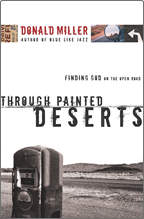
I just finished Donald Miller's book Through Painted Deserts. I had previously read Blue Like Jazz and Searching For God Knows What. I really enjoyed both of those books. I love Miller's style. I showed someone his Searching For God Knows What book, and the person flipped through it, and said, "He has a relaxed writing style." I agree. It's so easy. He draws you into the book.

If you are contemplating reading Blue Like Jazz, read this book first. It sets the stage. It's a prequel of sorts. Actually it's a rewrite of his first book Prayer and the Art of Volkswagen Maintenance.

In the book, Don and his friend Paul set out from Houston (Don's hometown) in 1971 VW van (the hippie van). They find all kinds of adventure. They meet some very interesting people along the way. They talk about life, girls, and everything.

I found myself wishing I could hop in an old VW van and hit the road for three months. I highly recommend this book, or the other two that I've read. I haven't read To Own a Dragon yet, but if it's anything like these I should be a great read.

I guess I should tell you what I learned from the book. Well, basically I have come to realized (although not entirely through this book) that the real issues of life aren't what we always think they are. As Miller says, we spend so much worrying about the how of life that we neglect the why of life. It's not about how I can get ahead, but why am I here and what does God want to do with me? Tough question with no easy answers.

Tuesday, July 25, 2006

Prayer: What's the point?

This kind of hit home to me this past Sunday. As I mentioned in my previous post, the church we were pastoring died. Now, we are going to a new church that is great. One thing I don't like, though, is the prayer time. It seems like it's the "let's-catch-up-on-the-gossip-of-the-church" time. Someone said (and the names have been changed, maybe), "The Doddleberry family isn't here this morning. They're having real problems. I don't know what they are, but they are going through some rough times." Gack! My wife said she almost stood up and said, "Be QUIET!" which isn't like her at all.

But that brings me to my question. What is the point of prayer?

This is how some view it:

  • It's a laundry list of wants. We toddle up to Santa God with our wish list of this, that and the other thing. Hopefully he sees that we've been good boys and girls, and we get all the cool presents we asked for.
  • It's gossip time. How is brother Elmo's flaky rash that he has on his butt?
  • It's candy time. We slide onto the lap of forgetul old geezer God and ask for a piece of candy. He seems to forget that it has been ages since we visited, but he's so happy to see us that he reaches into his pocket to give us pepperment flavored disc of sugar.
Is that all there is to prayer? I hope not.

In thinking about all this, I asked myself, "Self, why do you talk to that beautiful wife you have?"

I replied to myself, "Well, self, I want to get to know her better. Sure, we've been married quite a while, but I still learn things about her. Even when she's out of town, we talk on the phone."

I talk to and spend time with her to know. Isn't it the same with God. My wife is finite creature (albeit a gorgeous one). God is infinite. If I learn things about my finite wife after over a decade of marriage, how much more can I expect to learn about God. If talking to wife makes me closer to her, doesn't prayer bring me closer to God.

Prayer is less about we what can squeeze out of God, and more about getting closer to him.

Sunday, July 23, 2006

Where do I go and where do I fit?

My life in ministry has changed much over the last few months. The church that I was the pastor imploded and nothing is left. We have started attending another church, and have sought opportunities for ministry. (I can't stand doing nothing.) It's strange not being the one up front. One of the hard things, having preached every Sunday for nearly 4 years, is that I tend to listen with a critical ear. It's not critical in the sense that I say, "That was awful," but in the sense of this was good or that was bad in terms of delivery. It's hard to allow God to speak to me when I do that. I hate doing it.

I have never doubted God's call on my life to be where I'm at right now. I just want to do what God wants me to do.

The church family we are currently with is great. The people are nice and friendly. I really get the sense that they care, and that's cool. So many churches aren't like that.

Sometimes I wonder, though, if I fit in. I've always tended to be a sort of a loner, and that makes people think I'm aloof. All the questions run through my mind, "Will I fit in here? What will others think? Is this the right place?" I guess I'm a little insecure right now.

God is working me through this.

Monday, July 17, 2006

The little known (and thought of) characters of the Bible

I've been thinking some over the past few days about the "little guy" in the biblical narrative. I read Variety in Biblical Preaching (see previous post), and was struck by the things that were said about the narrative and dramatic monologue sermon. I had always come from the approach at looking at the "star of the show" and his/her perspective.

For example, I've been intrigued about the narrative of Elijah and the widow in 1 Kings 17 (the picture is one I found on the Internet depicting the scene). In the past, I would have looked at this from the viewpoint of Elijah, who was the "star of the show." We encounter Elijah at numerous points in the following chapters. He is a revered prophet in Jewish history. He stands out as a giant in the landscape.

But, what of the widow? Or, what of the son? Here is a boy who is being raised by a single mother. Widows at that time were destitute beyond anything we could imagine. We don't know the mother's name, much less the son's name. (Was it Bill? Or, Fred?) They were suffering from a drought, ready to eat their last meal and wait for starvation to overtake their bodies when Elijah walks into their life. He asks the mother for a drink and a biscuit.

From there the mother's flour and oil are endless in supply. This is a miracle from God. Then the boy gets sick and dies. (Who was this boy?) The mother blames Elijah for the calamity. All this after she had given up. Elijah prays for the boy and carries him back to his mother.

Who was the boy? I imagine (this is all speculation) he was a boy like any other boy. I sure he like to run and play (I know I did, when I was younger). I wonder how old his was. I can't imagine he was more than ten or so. The Bible says that Elijah carried him, so he couldn't have been too old, unless Elijah was a really strong man.

After this we hear nothing about the woman or the boy. Jesus made a reference to Elijah and the woman, but not the son. There is a passing reference to this episode in Hebrews. Beyond that? Nothing. Not a word. What happened to the boy later? Was he the talk of the town? You know, the boy that was dead then alive.

I think I'm going to work up a dramatic monologue sermon on this passage from the perspective of the boy.

Sunday, July 16, 2006

Variety is the spice of . . . Preaching

I just finished a book called Variety in Biblical Preaching by Harold Freeman. It was published in 1987. I believe it to be out of print at this time, as I was only able to find copies of it on the internet at "used" book sites. I cannot remember where I got this book. It was either as a part of lot from ebay or from another pastor. I was also a little skeptical that this book would be helpful, because it is nearly 20 years old.

Much to my surprise, it was a great book. It was an easy read. It was a quick read. It was packed with a great deal of help.

The main points are as follows:

1. Freeman is concerned with "biblical preaching." His concern is that the sermon is both faithful to the text of scripture and applicable to contemporary life. No matter what form of sermon a pastor would choose to use, the sermon must be biblical and applicable.

2. The first type of sermon discussed is the "dramatic monologue" in which the pastor enters the role of a biblical character to tell the story. For example, one would "become" Peter and reflect upon events that happened and deliver the message as Peter.

I have used this a couple times. The first time I did, I borrowed a sermon from a classmate in preaching class. I also wrote one of my own. I really liked doing these, and would like to do more of them in future.

3. The second type of sermon was the "dialogical message." This is when the minister "dialogues" with the congregation. There are numerous dangers in this method. Freeman asserts that one can be dialogical in principle while being monological in method. In this method the speaker anticipates questions that would arise from the congregation and answer them. It could go so far as allowing spontaneous questions and discussion.

The danger is that open-ended discussion can cause people to think that anything goes. Freeman says that questions can be predetermined, but that could seem contrived. If one is to use the dialogical method, one has to be careful.

4. The third type is the "narrative message." Freeman notes that the main difference between this and the dramatic monologue is that the narrative message is told in the third person rather than first person. The preacher retells the biblical story, either as it occurred or in a modern, updated form.

I have used this, especially with the parables of Jesus. I told the story in modern form, read the scripture and the offered application. (I'll talk more about application in a minute.)

5. He discussed briefly the "media-augmented message," the "inductive message," the "segmented sermon," and the "drama-augmented sermon."

a. In the discussion of the media-augmented message, the books age is most clear. He talks of slides rather than PowerPoint.

b. The inductive message is basically the reverse of the traditional sermon.

c. The segmented sermon is just that, segmented. One would preach for a time, take a break to do a reading or sing, then preach some more. I used this once on the International Day of Prayer for the Persecuted Church; it went well.

d. The drama-augmented sermon is basically where one would have people act out the scene before, or during, the message.

When it comes to application, Freeman seems to prefer direct application where the minister tells the congregation directly what the application is. Indirect application can lead to subjective application.

If you can find the book, I recommend it.

Thursday, July 6, 2006

Relationship is what matters


I recently finished reading (for the second time) a wonderful little book by Michael Lodahl and Thomas Jay Oord called Relational Holiness. The authors seek to find the "core notion of holiness." In an effort to find that core they explore the "contributing notions of holiness." They list several, but I think you can boil it down to two streams of thought. Essentially holiness has been understood in three ways (two contributing and one main). Two of these ways are the boiled down version of Lodahl and Oord's contributing notions.

First, you have holiness by right actions. This is little more than rule keeping. This is the holiness model I was raised with. It did not matter why you kept the rules, so long as you kept the rules. We did not smoke, drink alcohol, dance, go to movies (however, we could watch them on TV or video), wear two-piece bathing suites, etc. The wise counsel of the church elite crafted a list. One was holy if one followed the rules.

Second, you have holiness as right belief. This is the fundamentalist view. As long as you hold a certain set of beliefs you are okay. The beliefs may vary from place to place and time to time, but no one should ever question the belief. Our actions really do not matter so long as we believe the correct things.

Third, you have holiness as right relationship. This would include our relationship with God and others. Jesus was once asked what the greatest commandment was. He replied, "
Love the Lord your God with all your heart and with all your soul and with all your mind." He went on to add, "Love your neighbor as yourself." At another time Jesus clarified who our neighbor is. It is any other member of the human race (white, black, Latino, Asian, Christian, Jew, Muslim, heterosexual, homosexual, or any other label we slap on someone). When our relationships are right, we are holy. We love God and we love others. Lodahl and Oord suggest that love is the core notion of holiness.

The thing about relationships is that they are dynamic. They change. My relationship with my wife is different than it was when we got married. It is different than it was a year ago. My relationship with God is changing. It ebbs and flows. What God wanted me to do ten years ago is not necessarily what he wants me to do today.

The bottom line is this: God cares more about a relationship than he does about rules and beliefs.

The problem is that relationships are not quantifiable. I cannot quantify how much I love my kids. I cannot quantify my relationship with God. Rules, on the other hand, are easily quantifiable. I went to church this many times. I read this many chapters of the Bible. I don't smoke. I don't dance. Beliefs are also quantifiable. I believe this, that and the other thing. Rules and beliefs are also transferable to others. Everyone will follow the same rules and hold the same beliefs. Relationships look different for everyone. My relationship with God will look very different from yours.

Relationship is what matters.